
In commitment to implementing the Company’s strategic and future plans, and in adherence to the rights of shareholders and other stakeholders, National Consumer Holding Company operates within a governance framework built on oversight, accountability, the promotion of professional conduct, and sound administrative organization.
The Company manages its day-to-day operations in accordance with the rules, policies, and regulations set by the Board of Directors, in full compliance and alignment with the Capital Markets Authority Law and the Kuwaiti Companies Law governing the application of corporate governance principles.
The Board of Directors, executive management, and all employees bear full responsibility for implementing these governance principles, in the firm belief that they represent the fundamental pillar for enhancing the quality of work and achieving the Company’s objectives.
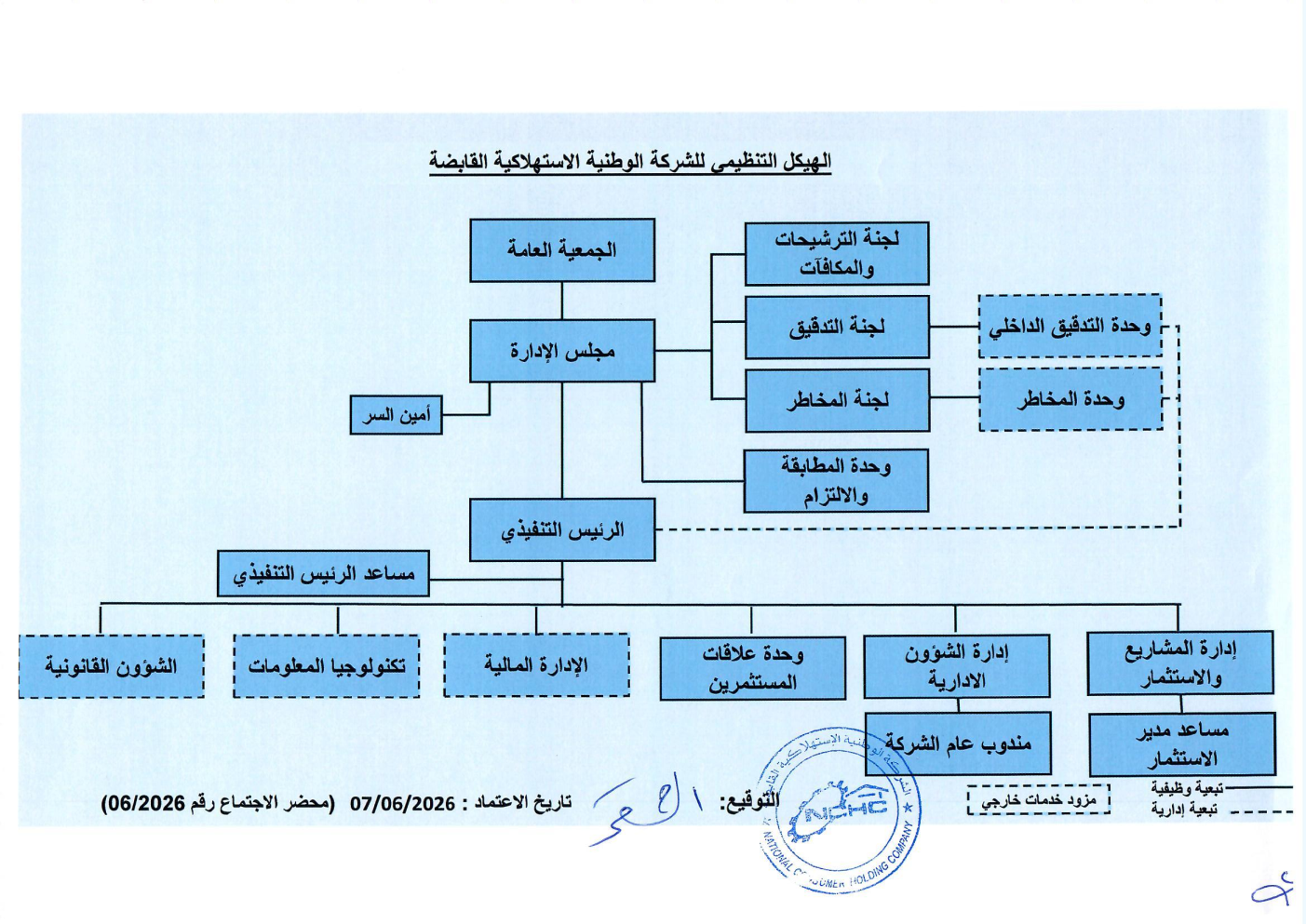
General Responsibilities of the Board of Directors
The Board of Directors bears the overall responsibility for the National Consumer Holding Company, including setting the company’s strategic objectives, risk strategy, and governance standards, as well as ensuring the implementation and supervision of these objectives and standards. The Board is also responsible for overseeing the executive management, including the Chief Executive Officer.
The Board assumes full responsibility for the operations of the National Consumer Holding Company, its financial integrity, ensuring compliance with regulatory requirements, safeguarding the interests of shareholders, creditors, employees, and other stakeholders, and ensuring that the company is managed prudently within the framework of applicable laws, regulations, and the company’s internal policies.
Oversight of Executive Management
The Board of Directors shall appoint a Chief Executive Officer for the company who possesses integrity, technical competence, and professional experience. The appointment of executive management members shall be subject to Board approval after verifying their qualifications and expertise to ensure their suitability for the nature of the company’s activities and their ability to achieve the company’s objectives and strategy.
Executive management shall operate under the supervision of the Chief Executive Officer or the Chairman of the Board. The Board shall also provide adequate oversight over executive management to ensure that it fulfills its responsibilities in achieving the objectives and purposes of the National Consumer Holding Company and in implementing the policies approved by the Board.
Board Composition
The Board of Directors consists of five members (executive / non-executive / independent), enabling it to form the necessary committees in accordance with sound corporate governance standards issued by the Capital Markets Authority.
Role of the Chairman of the Board
The Chairman of the Board plays an important role in ensuring the proper functioning of the Board’s activities, maintaining mutual trust among members, and ensuring that Board decisions are based on sound information and proper foundations. The Chairman also encourages the exchange of views within the Board, ensures that sufficient information reaches Board members and shareholders in a timely manner, and confirms the existence of sound governance standards within the National Consumer Holding Company. The Chairman serves as the link between the Board and executive management.
Organization of Board Activities
Board meetings are held whenever necessary, provided that the Board meets no fewer than six times annually. Decisions taken during Board meetings are binding and form part of the official records of the National Consumer Holding Company.
The Chairman, in consultation with executive management, determines the important matters proposed for inclusion in the Board meeting agenda. Board members are provided with sufficient data and information well in advance of meetings to enable them to make informed decisions. The Board Secretary records the Board’s discussions, members’ proposals, and voting results during meetings. The responsibilities of the Chairman and Board members must be documented in writing and must not conflict with applicable laws and regulations.
Board Secretary
The role of the Board Secretary is to assist the Board and its Chairman in managing Board affairs, including the following:
- Ensuring the timely preparation of Board minutes in coordination with the Chairman and the Chief Executive Officer.
- Organizing and coordinating with members regarding attendance at Board meetings and receiving the agenda and all related documents sufficiently in advance of meetings.
- Maintaining records and drafts of Board meeting minutes.
- Implementing any instructions issued by the Board.
- Ensuring compliance with all legal requirements relating to Board affairs.
Powers of Board Members
- The Board of Directors may obtain all available information for discussion during and prior to meetings.
- Members shall be granted sufficient time to study and discuss issues.
- Members shall have access to the necessary and reliable information, including access to employees, and shall have the right to obtain such resources and information from the National Consumer Holding Company through appropriate channels whenever required.
Delegated Authority
The Board of Directors has delegated the Chairman of the Board to undertake specific duties in addition to those stipulated under the Commercial Law. The Board has also delegated the Chief Executive Officer to manage the company’s operations and affairs.
Qualifications of the Board
Members of the Board of Directors and its committees must possess diverse qualifications and expertise in order to serve the interests of the company, its shareholders, and stakeholders.
Effectiveness
The Board is required, at least once annually, to review and evaluate the performance of Board members, committees formed by the Board, and all managers appointed by the Board.
Board Members
- Sheikh / Ahmad Ali Al-Sabah – Chairman of the Board
- Mr. / Ahmad Al-Gumar – Vice Chairman & Chief Executive Officer
- Mr. / Mubarak Ali Al-Hamdan – Representative of Senatco International General Trading Company
- —
- Mr. / Ahmad Tareq Al-Ghanim – Board Member
- Mr. / Abdullah Abdulkarim Al-Fadhli – Board Secretary
The Board of Directors carries out its duties with the support of three main committees. The responsibilities, duties, and delegated authorities of each committee are determined by the Board of Directors.
Risk Management and Internal Audit Committee
The existence of a Risk Management and Internal Audit Committee is considered one of the key indicators of sound corporate governance practices. The Committee works to reinforce a culture of compliance within the company by ensuring the integrity and accuracy of financial reports, as well as verifying the adequacy and effectiveness of the company’s internal control systems.
The Committee also enhances the company’s performance effectiveness through understanding and analyzing the nature and size of risks facing the company’s activities and working to mitigate them as much as possible in order to achieve the company’s vision in line with approved policies and standards.
The Committee is entitled, based on the powers delegated to it by the Board, to review and examine all information, data, reports, records, and correspondence related to the company’s activities or any other matters the Committee deems important to ensure the effective performance of risk management and internal audit functions in line with the company’s objectives. The Committee periodically submits observations and recommendations related to completed risk management and internal audit activities to the Board of Directors and executive management.
Audit Committee Members
- Mr. Mubarak Ali Al-Hamdan – Committee Chairman
- — – Committee Member
- Mr. Ahmad Tareq Al-Ghanim – Committee Member
- Mr. Abdullah Abdulkarim Al-Fadhli – Committee Secretary
Risk Committee Members
- — – Committee Chairperson
- Mr. Ahmad Al-Gumar – Committee Member
- Mr. Mubarak Ali Al-Hamdan – Committee Member
- Mr. Abdullah Abdulkarim Al-Fadhli – Committee Secretary
Nomination and Remuneration Committee
The objectives of the Nomination and Remuneration Committee are to enhance effectiveness and performance through participating in the selection of qualified Board members and senior executives capable of achieving the company’s vision in line with approved policies and standards, as well as developing the remuneration policy for Board members and senior executives of the company.
The Committee also provides recommendations to the Board of Directors regarding the skills and qualifications required for Board membership in order to achieve the company’s objectives and protect the interests of shareholders and investors efficiently and at a reasonable cost.
The Committee has the unrestricted right to review and examine all information, data, reports, records, and correspondence related to Board nomination processes, appointments of senior executives, and compensation data relating to the Chairman, Board members, and senior executives, as well as any other matters within its scope of responsibility that the Committee deems important. The Committee periodically submits recommendations to executive management and the Board of Directors. The Board shall take all necessary actions to enable the Committee to perform its duties effectively.
Nomination and Remuneration Committee Members
- Sheikh Ahmad Ali Al-Sabah – Committee Chairman
- — – Committee Member
- Mr. Ahmad Tareq Al-Ghanim – Committee Member
- Mr. Abdullah Abdulkarim Al-Fadhli – Committee Secretary
National Consumer Holding Company has established a clear policy for the remuneration of Board members and executive management. The Nomination and Remuneration Committee is responsible for preparing a detailed annual report on all remuneration granted to Board members and executive management, whether in the form of payments, benefits, or privileges, regardless of their nature or designation.
This report shall be presented to the company’s General Assembly for approval and shall be read by the Chairman of the Board of Directors.
The company is required to adhere to standards of accuracy and transparency when preparing the remuneration report, ensuring the disclosure of all remuneration granted, whether direct or indirect, and avoiding any attempt at concealment or misleading disclosure.
The Board of Directors of the National Consumer Holding Company seeks to fulfill its commitment to representing shareholders and stakeholders. As part of this commitment, the company has established policies and procedures to ensure fair representation of the company so that current and potential investors are adequately informed regarding investment decisions.
Investor Relations Policy
- The company consistently announces its financial results and material developments to the stock market, shareholders, and stakeholders in a transparent and comprehensive manner.
- The company communicates and makes announcements through its authorized spokespersons.
- The company uses its website as an additional communication channel.
- The company proactively addresses news and rumors in order to avoid speculation in its shares.
- The company provides information to analysts and media representatives to assist them in expressing their opinions about the company without influencing those opinions.
- The company seeks to meet with shareholders at least once during each financial year as part of its ongoing communication program and to obtain their feedback regarding the company.
- Any non-public information that is unintentionally disclosed to analysts, investment professionals, or any shareholder who may exploit such information for trading purposes shall be immediately disclosed to investors and stakeholders.
Stakeholders are defined as any party or organization that has an interest in the company and may either affect or be affected by the company’s actions, objectives, and policies. Stakeholders in any company include investors, employees, customers, and suppliers.
The expectations of stakeholders may vary and sometimes conflict with one another. Therefore, the company is responsible for maintaining a balance between the interests of stakeholders and its own interests.
Internal Stakeholders
Internal stakeholders are groups within the business organization, such as shareholders, managers of subsidiary companies’ factories, and employees.
External Stakeholders
External stakeholders are groups outside the business organization, such as suppliers and customers.
Ensuring shareholders’ rights is considered one of the most important requirements stipulated by corporate governance rules as well as the Companies Law. In its commitment to providing the highest standards of transparency and equality in all current and potential shareholder dealings, the company has established a policy to identify and protect shareholders’ rights in accordance with the company’s Articles of Association, internal policies, regulations, procedures, and necessary controls.
This is intended to ensure that all shareholders are able to exercise their rights fairly and equally, in a manner that does not conflict with applicable laws, regulations, decisions, and instructions.
The company also seeks to treat all shareholders holding the same class of shares equally and fairly without discrimination.
The National Consumer Holding Company is committed to continuously monitoring all matters relating to shareholders’ data. Accordingly, the company has established and maintained a special register kept with the Clearing Agency, in which the names, nationalities, domiciles, and number of shares owned by each shareholder are recorded. Any changes to the registered data are updated in accordance with the information received by the company or the Clearing Agency. Any interested party has the right to request information from this register from either the company or the Clearing Agency.
Encouraging Shareholders to Participate and Vote in General Assembly Meetings
In order to facilitate and clarify the role of shareholders in General Assembly meetings, the National Consumer Holding Company has established a mechanism for participation and voting in General Assembly meetings. This mechanism clarifies that shareholders have the right to vote on resolutions during such meetings, and that voting is an inherent right of all shareholders regardless of their ownership level, as stipulated in the Articles of Association, Memorandum of Association, Shareholders’ Rights Policy, and the regulations governing shareholders’ meetings.
The company also organizes General Assembly meetings in a manner that enables shareholders to effectively participate and discuss the items listed on the meeting agenda.
In addition, the company ensures that shareholders have the right to review all information contained in the disclosure register relating to members of the Board of Directors and executive management.
As part of its corporate governance framework, the company has established a Conflict of Interest Policy Manual, including the necessary methods and procedures for addressing and managing conflicts of interest. These requirements are intended to prohibit such conduct by members of the Board of Directors and executive management and to ensure the separation of personal interests from their official responsibilities within the company.
The purpose of these policies is to assist the company, its direct and indirect subsidiaries, Board members, and executive management in identifying and promoting the company’s organizational values, as well as ensuring sound management practices for actual and potential conflict of interest situations.
The National Consumer Holding Company is committed to conducting its business in a fair and proper manner to ensure the achievement of the long-term interests of shareholders. As part of this commitment, the company has implemented the necessary policies and procedures for fair and ethical business practices and conduct, which are expected from both Board members and employees alike.
These policies and procedures apply to all company employees, suppliers, officers, and members of the Board of Directors.
In accordance with the Corporate Governance Regulations issued by the Capital Markets Authority concerning the principles of full disclosure of material information, which aim to achieve fairness, transparency, and prevent conflicts of interest, and as part of the National Consumer Holding Company’s commitment to implementing sound corporate governance principles, the company has adhered to organized procedures for the disclosure of material information and the mechanisms for announcing such information in a manner that also fulfills the company’s legal and ethical obligations.
The company is committed to ensuring the timely disclosure of material information related to its activities, including its financial position and management performance, to the relevant parties. This enables stakeholders to better understand the company’s strategy and practices and facilitates the evaluation of its performance.
National Consumer Holding Company is committed to promoting professional conduct, integrity, honesty, and the development of corporate values in order to enhance investors’ confidence in the company’s integrity and the reliability of its financial information. As part of this commitment, the Board of Directors has established a Code of Conduct, including a Conflict of Interest Policy for Board members and executive management, aimed at encouraging sound practices, ethical behavior, and protecting the long-term interests of stakeholders.
Integrity is considered the company’s highest core value and serves as the guiding principle for employees in all their activities. Therefore, emphasizing integrity strengthens a work culture based on ethical standards and ethical decision-making.
Ethical orientation and conduct support value-based decisions when providing services to customers and conducting business operations. The company takes pride not only in acting in the best interests of the business, but also in serving the interests of stakeholders, including the communities in which it operates.
To support these principles, a Professional and Ethical Standards Manual has been prepared to assist members of the Board of Directors and executive management in performing their duties through a system founded on ethical values. The principles and values contained in this manual form an integral part of the company’s strict commitment to preserving its reputation and maintaining public trust.
This manual defines the ethical expectations for members of the Board of Directors and executive management within the company. All employees are obligated to know, understand, and comply with this manual in both form and substance. This obligation includes carrying out all duties and responsibilities, including the reporting of any potential violations.
In accordance with the Corporate Governance Regulations issued by the Capital Markets Authority regarding the reporting of fraud and corruption violations that may occur and negatively affect the working environment within the National Consumer Holding Company, the Board of Directors has emphasized the importance of establishing a policy manual and specific procedures governing the mechanisms and processes for reporting fraud and corruption violations, as well as implementing approved procedures that encourage all employees to raise important concerns without affecting their employment status.
The company aims to ensure that any violations, fraudulent acts, or misconduct that may harm the company’s reputation or financial position are reported in a timely manner to the relevant authorities capable of taking appropriate corrective action. The company also seeks to provide a proper framework for addressing genuine concerns raised by employees while ensuring the necessary protection against retaliation, abuse, or disciplinary actions, and encouraging employees to report any crimes or workplace violations in a responsible and ethical manner.
Complaints Contact Information
For complaints, please contact:
- Telephone: +965 22493267
- Email: info@nccikw.com
Whistleblowing Report Form
To complete this form, please provide the following details regarding any suspected misconduct, violation, breach of law, or regulations that may negatively affect the company. You may be requested to assist in the investigation process if necessary.
Note: Please follow the procedures outlined in the Whistleblowing Policy.
The purpose of internal reporting by employees or external parties regarding any improper practices, suspicious matters related to financial reports, internal control systems, or any other matters that may negatively affect the company, and which may be committed by any employee affiliated with the company, is to protect the company and all related parties, particularly shareholders. Accordingly, in pursuit of transparency, the company shall guarantee the whistleblower complete privacy and confidentiality in handling the report and shall ensure protection against any negative reaction or harm resulting from reporting suspicious practices.
Whistleblower Contact Information
(This section may remain blank if the whistleblower wishes to remain anonymous.)
- Name
- Job Title
- Department
- Telephone Number
- Email Address
Suspected Person Information
- Name
- Job Title
- Department
- Telephone Number
- Email Address
Witness Information (If Any)
- Name
- Job Title
- Department
- Telephone Number
- Email Address
Complaint Details
Please briefly describe the misconduct or improper behavior and explain how you became aware of it. If there is more than one allegation, please specify each allegation separately and use additional forms if necessary.
- Describe the misconduct or improper behavior that occurred.
- State the name of the person responsible for the misconduct or improper behavior.
- Specify the date, day, and time of the incident or violation.
- Specify the location where the misconduct or violation occurred.
- Provide detailed evidence or indications supporting the complaint, if available.
- Provide details of any documents submitted with the complaint, if available.
- Mention any other parties involved with the suspected person in the misconduct or improper behavior.
- Please provide any additional information that may support the investigation process.
- Other remarks.
Declaration
- Date:
- Signature:
The completed form should be sent to the following email address:
The Board of Directors of the company is committed, in accordance with the instructions of the Capital Markets Authority regarding the principles of sound corporate governance, to fulfilling its social responsibility toward stakeholders, employees, and the community, as well as achieving social and environmental objectives alongside the company’s economic objectives.
The company is committed to continuously upholding its social responsibility through socially responsible practices aimed at achieving sustainable development for society in general and for its employees in particular. This is achieved through initiatives intended to improve the living conditions of employees and their families, support the community, reduce unemployment rates, and minimize the waste of environmental resources.
The company also aims to enhance management practices by integrating social and environmental issues into its operations and relationships with stakeholders. Corporate social responsibility paves the way for the company to achieve a balance between economic, environmental, and social necessities while meeting the expectations of shareholders and stakeholders, contributing to poverty reduction, improving the company’s reputation, and strengthening its brand image. However, the concept of corporate social responsibility extends beyond these objectives.
The proper implementation of corporate social responsibility can lead to numerous competitive advantages, including better opportunities for obtaining capital and accessing markets, increased sales, reduced operating costs, improved productivity and quality, enhanced corporate reputation and image, stronger customer loyalty, and improved decision-making and risk management processes.